
Alexion is committed to providing free assistance to you and your family with our team of support specialists. Our specialists will be available during every step of the journey, from considering Koselugo to being treated with Koselugo.
Your patient education manager (PEM) is available to meet in person or virtually. If you have questions about neurofibromatosis type 1 (NF1) plexiform neurofibromas (also known as plexiforms) or how Koselugo works, or just need someone to listen, your PEM is here for you.
PEMs engage with the community by:
PEMs engage with the community by:
- hosting national educational webinars
- partnering with patient advocacy groups
- coordinating one-on-one or group interactions
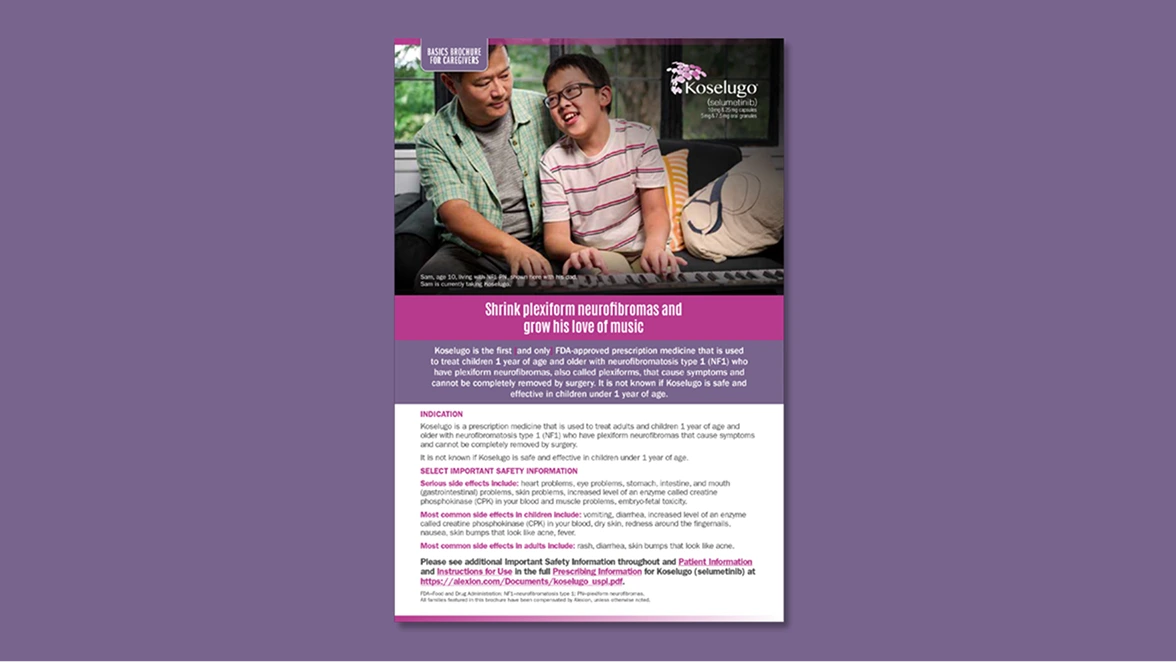
Once you or your loved one is prescribed and ready to start taking Koselugo, you may be eligible to enroll in Alexion's free patient support program called OneSource.
Once you’re enrolled in OneSource, a dedicated Alexion Case Manager is ready to coordinate and help navigate the logistics of starting and staying on treatment.
They can help by:
- Navigating insurance coverage
- Answering treatment questions, including about possible side effects
- Offering practical support
- Addressing financial concerns
- Assisting in avoiding treatment interruptions
The OneSource CoPay Program helps cover some out-of-pocket costs for eligible Koselugo patients.
To get started, you must:- Be signed up for patient services through OneSource
- Have commercial insurance (not part of a federal or state-funded healthcare program)
- Be prescribed Koselugo for an FDA-approved indication
- Reside in the United States or its territories
Learn if you're eligible.
*Please refer to the full CoPay Terms and Conditions for additional eligibility requirements.
To learn more or get started with OneSource, click on the button below or call 1-888-765-4747, Monday through Friday, 8:30 AM–8 PM ET.
IMPORTANT SAFETY INFORMATION
What are the possible side effects of Koselugo?
Koselugo may cause serious side effects, including:
Before taking Koselugo, tell your healthcare provider about all your medical conditions, including if you:
What should I avoid while taking Koselugo?
Avoid St John’s wort, grapefruit or grapefruit juice, and Seville oranges during treatment.
Most common side effects in children include: vomiting, diarrhea, increased level of an enzyme called creatine phosphokinase (CPK) in your blood, dry skin, redness around the fingernails, nausea, skin bumps that look like acne, fever.
Most common side effects in adults include: rash, diarrhea, skin bumps that look like acne.
These are not all the possible side effects of Koselugo. Call your healthcare provider for medical advice about side effects. You may report side effects to AstraZeneca at 1-800-236-9933 or at https://us-aereporting.astrazeneca.com or FDA at 1-800-FDA-1088 or www.fda.gov/medwatch.
INDICATION
What is Koselugo?
Koselugo is a prescription medicine that is used to treat adults and children 1 year of age and older with neurofibromatosis type 1 (NF1) who have plexiform neurofibromas that cause symptoms and cannot be completely removed by surgery.
It is not known if Koselugo is safe and effective in children under 1 year of age.
Please see Patient Information and Instructions for Use in the full Prescribing Information for Koselugo (selumetinib) or at https://alexion.com/Documents/koselugo_uspi.pdf.
What are the possible side effects of Koselugo?
Koselugo may cause serious side effects, including:
- Heart problems. Koselugo can lower the amount of blood pumped by your heart, which can be severe. Your healthcare provider will do tests before and during treatment to check how well your heart is working. Tell your healthcare provider right away if you get any of the following signs or symptoms: persistent coughing or wheezing, shortness of breath, swelling of your ankles and feet, tiredness, increased heart rate.
- Eye problems. Koselugo can cause eye problems that can lead to blindness. Your healthcare provider will check your vision before and during treatment. Tell your healthcare provider right away if you get new or worsening vision changes, including: blurred vision, loss of vision, dark spots in your vision (floaters), other changes to your vision.
- Stomach, intestine, and mouth (gastrointestinal) problems. Koselugo can cause diarrhea, vomiting, nausea, and mouth sores. Diarrhea can be severe with Koselugo. Tell your healthcare provider right away the first time that you get diarrhea during treatment. Your healthcare provider may give you medicine to help control your diarrhea and may tell you to drink more fluids.
- Skin problems. Koselugo can cause severe skin rashes. Tell your healthcare provider if you get any of the following signs of skin problems: rash that covers a large area of your body, flat skin rash, raised bumps on your skin, skin bumps that look like acne, blisters, peeling skin, itchy rash, hair thinning or hair loss (alopecia).
- Increased level of an enzyme called creatine phosphokinase (CPK) in your blood and muscle problems. Koselugo can cause severe muscle problems. Treatment with Koselugo may increase the level of an enzyme in your blood called creatine phosphokinase (CPK), which may be a sign of muscle damage. Increased level of CPK in the blood is common during treatment and can also be severe. Your healthcare provider should do a blood test to check your blood levels of CPK before you start taking Koselugo and during treatment. Tell your healthcare provider right away if you get any of the following signs or symptoms: muscle aches or pain; muscle spasms and weakness; dark, reddish urine.
Before taking Koselugo, tell your healthcare provider about all your medical conditions, including if you:
- Have heart problems.
- Have eye problems.
- Have liver problems.
- Females who are able to become pregnant:
- Your healthcare provider should check to see if you are pregnant before you begin treatment.
- You should use effective birth control (contraception) during treatment and for 1 week after your last dose.
- Tell your healthcare provider right away if you become pregnant or think you may be pregnant during treatment.
- Males with female partners who are able to become pregnant:
- You should use effective birth control (contraception) during treatment and for 1 week after your last dose.
- Are breastfeeding or plan to breastfeed. It is not known if Koselugo passes into your breast milk. Do not breastfeed during treatment and for 1 week after your last dose. Talk to your healthcare provider about the best way to feed your baby during this time.
What should I avoid while taking Koselugo?
Avoid St John’s wort, grapefruit or grapefruit juice, and Seville oranges during treatment.
Most common side effects in children include: vomiting, diarrhea, increased level of an enzyme called creatine phosphokinase (CPK) in your blood, dry skin, redness around the fingernails, nausea, skin bumps that look like acne, fever.
Most common side effects in adults include: rash, diarrhea, skin bumps that look like acne.
These are not all the possible side effects of Koselugo. Call your healthcare provider for medical advice about side effects. You may report side effects to AstraZeneca at 1-800-236-9933 or at https://us-aereporting.astrazeneca.com or FDA at 1-800-FDA-1088 or www.fda.gov/medwatch.
INDICATION
What is Koselugo?
Koselugo is a prescription medicine that is used to treat adults and children 1 year of age and older with neurofibromatosis type 1 (NF1) who have plexiform neurofibromas that cause symptoms and cannot be completely removed by surgery.
It is not known if Koselugo is safe and effective in children under 1 year of age.
Please see Patient Information and Instructions for Use in the full Prescribing Information for Koselugo (selumetinib) or at https://alexion.com/Documents/koselugo_uspi.pdf.
FDA=Food and Drug Administration; NF1=neurofibromatosis type 1; PN=plexiform neurofibromas.