
Navigating a diagnosis of neurofibromatosis type 1 (NF1) plexiform neurofibromas, or plexiforms, can be overwhelming, but you’re not alone. Hear from caregivers of children and teens with NF1 plexiforms and follow their journeys from diagnosis to treatment with Koselugo.
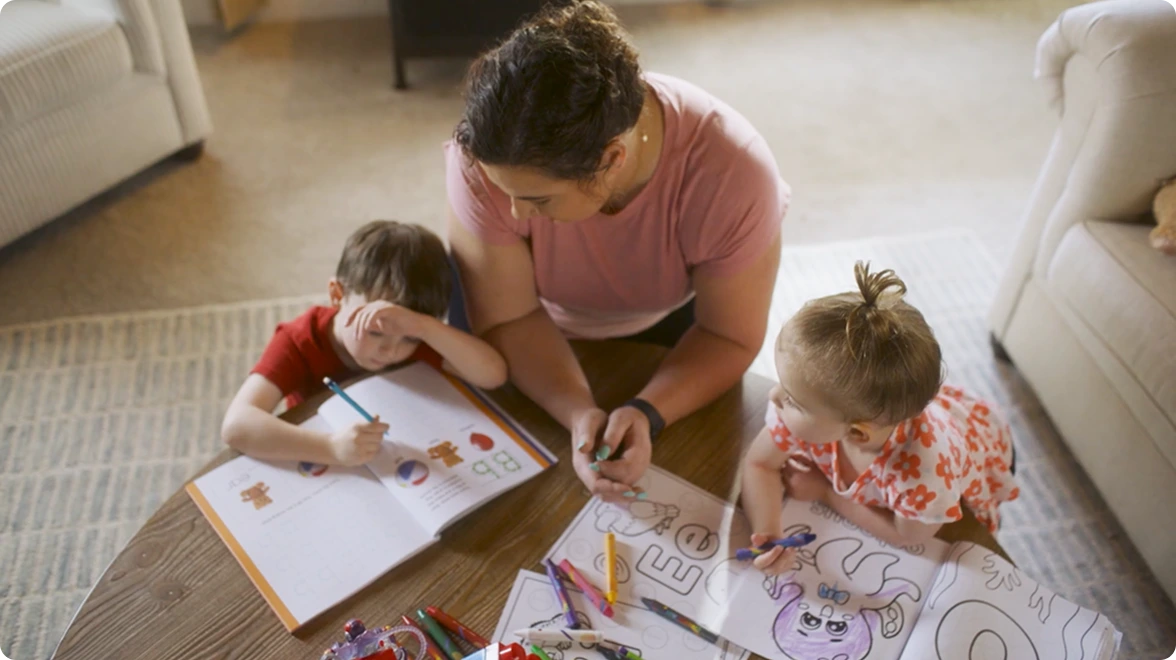
Natalie discusses Kamie's plexiform journey, from learning how critical timely evaluation and intervention are to sharing Kamie's experience with Koselugo.
The doctors have been pleased with her results on Koselugo. She has not had tumor growth.*
Natalie, Kamie's mom
*In the SPRINT study, 66% (33/50) of children and teens with NF1 saw their plexiform shrink by at least 20% with Koselugo.
Natalie discusses Kamie's plexiform journey, from learning how critical timely evaluation and intervention are to sharing Kamie's experience with Koselugo.
NF1 does not define who he is as a person.
Kim, Quentin's mom
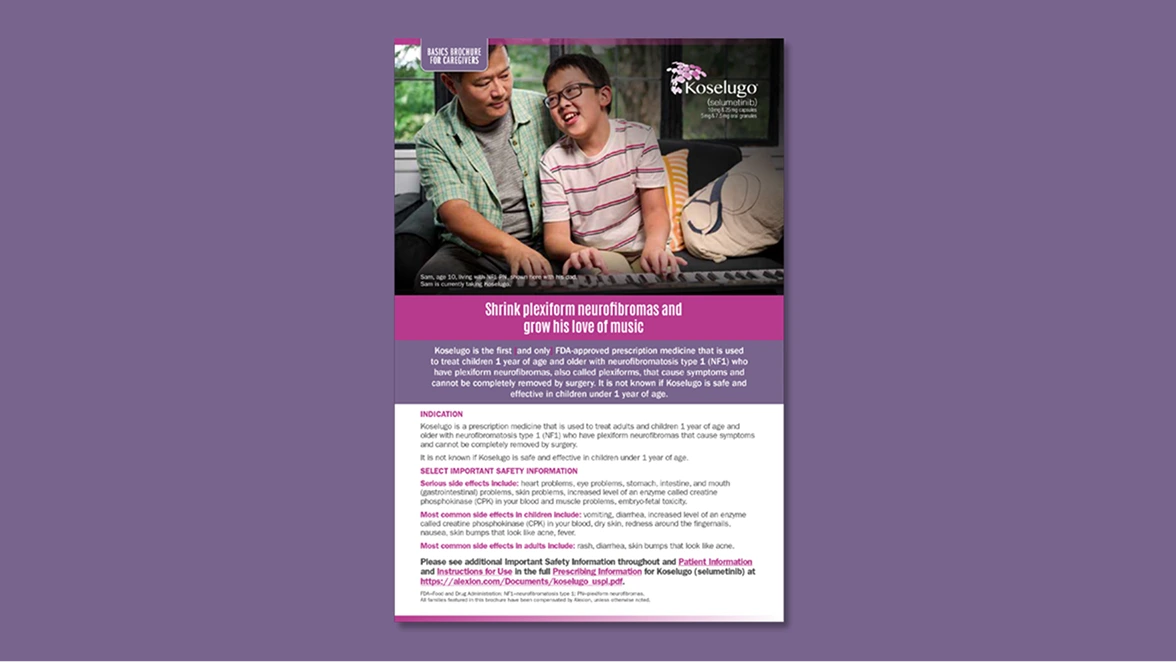
Follow Quentin's journey as he grows into adulthood and takes on more responsibility in managing his treatment.
Quentin:
Turning 18 is a big milestone, especially for me. I have one more year left of high school. I really just want to go into the workforce.
I am still trying to figure out what’s going to happen with my healthcare in the future.
Hi, my name is Quentin, and I take Koselugo (selumetinib) to treat my NF1 PN.
I started taking Koselugo when I was part of the clinical trial at the age of five, and I’ve been taking it for 13 years. It has helped me manage my plexiforms over the years, and the continuous dosing still works with my changing routine.
I have experienced some side effects like diarrhea, eczema, and hair loss, but I also have made progress. My tumors have not
been growing.
Kim:
My name is Kim. My son, Quentin, has neurofibromatosis type 1 with plexiform neurofibromas, or PN. He has a neuro-oncologist, a cardiologist. He sees an ophthalmologist. Most of his specialists are based at a children’s hospital. As he was approaching 18, there was some trepidation of whether or not he could stay.
Quentin:
I don’t think every children’s hospital has the same policies, but I will be—be able to see my doctor until they either leave the hospital, or I find a new doctor.
Kim:
To know that partnership can stay on and Quentin can continue to manage it on his own as an adult is huge for me.
Quentin:
My mom is still involved, and I’m taking more ownership in my healthcare. She’s showing me how to ask the questions to the doctors, how to set up the healthcare app, how to make appointments.
I’m a little nervous about the extra responsibility, transitioning to adulthood, but it feels good to have more power and control over my own care. I just take it day by day, appointment by appointment.
Kim:
As his mom and his caregiver, you know, it’s a little scary. Koselugo is more than just a medication.
There is a team that comes behind it. You know, there’s OneSource, there’s the patient education manager, and to know that there are all these resources makes me feel a little better about handing things over to him.
When Quentin moves into the workforce and is at a certain point, he will have to look at being able to get his own medication covered. OneSource can direct him who he needs to speak with. I am so glad that they will be there to help him navigate this next chapter of his life.
My hope is that I’ve set him up on the right path for managing his NF1 PN. I feel that he will be able to conduct himself and be able to manage his care pretty well.
Quentin:
Koselugo has been with me since I was a kid, and I’m happy to be able to take it as an adult. I want to keep educating people about NF1, and teach them about Koselugo as a treatment option. Having the support from the Koselugo
team and my family, it makes me feel not alone. I want other people to know that they are not alone, either.
Turning 18 is a big milestone, especially for me. I have one more year left of high school. I really just want to go into the workforce.
I am still trying to figure out what’s going to happen with my healthcare in the future.
Hi, my name is Quentin, and I take Koselugo (selumetinib) to treat my NF1 PN.
I started taking Koselugo when I was part of the clinical trial at the age of five, and I’ve been taking it for 13 years. It has helped me manage my plexiforms over the years, and the continuous dosing still works with my changing routine.
I have experienced some side effects like diarrhea, eczema, and hair loss, but I also have made progress. My tumors have not
been growing.
Kim:
My name is Kim. My son, Quentin, has neurofibromatosis type 1 with plexiform neurofibromas, or PN. He has a neuro-oncologist, a cardiologist. He sees an ophthalmologist. Most of his specialists are based at a children’s hospital. As he was approaching 18, there was some trepidation of whether or not he could stay.
Quentin:
I don’t think every children’s hospital has the same policies, but I will be—be able to see my doctor until they either leave the hospital, or I find a new doctor.
Kim:
To know that partnership can stay on and Quentin can continue to manage it on his own as an adult is huge for me.
Quentin:
My mom is still involved, and I’m taking more ownership in my healthcare. She’s showing me how to ask the questions to the doctors, how to set up the healthcare app, how to make appointments.
I’m a little nervous about the extra responsibility, transitioning to adulthood, but it feels good to have more power and control over my own care. I just take it day by day, appointment by appointment.
Kim:
As his mom and his caregiver, you know, it’s a little scary. Koselugo is more than just a medication.
There is a team that comes behind it. You know, there’s OneSource, there’s the patient education manager, and to know that there are all these resources makes me feel a little better about handing things over to him.
When Quentin moves into the workforce and is at a certain point, he will have to look at being able to get his own medication covered. OneSource can direct him who he needs to speak with. I am so glad that they will be there to help him navigate this next chapter of his life.
My hope is that I’ve set him up on the right path for managing his NF1 PN. I feel that he will be able to conduct himself and be able to manage his care pretty well.
Quentin:
Koselugo has been with me since I was a kid, and I’m happy to be able to take it as an adult. I want to keep educating people about NF1, and teach them about Koselugo as a treatment option. Having the support from the Koselugo
team and my family, it makes me feel not alone. I want other people to know that they are not alone, either.
Peer Connects is a program that connects people living with NF1 plexiforms and their caregivers with others who have gone through similar experiences. Living with a rare disease can be challenging. Whether you've been diagnosed or are caring for a loved one who has, talking to someone who can relate may help you on your journey.
If you or a loved one is impacted by NF1 plexiforms, we encourage you to share your story to educate, inspire, and support others through the STAR Ambassador Program.
To learn more about the STAR Ambassador Program, get in touch with us by calling 1-888-765-4747 or emailing us at mystory@starsambassador.com.
To learn more about the STAR Ambassador Program, get in touch with us by calling 1-888-765-4747 or emailing us at mystory@starsambassador.com.
The following organizations can help you connect with the NF community and learn valuable information about the condition.
The mission of the Children's Tumor Foundation is to drive research, expand knowledge, and advance care of the NF community.
Find a doctor through the Children's Tumor Foundation.
Find a doctor through the Children's Tumor Foundation.
Visit the Neurofibromatosis Network website to discover news about treatment and their work toward a neurofibromatosis cure. They provide outreach through education and awareness, while offering hope and support to those affected by NF.
Find a doctor through the Neurofibromatosis Network.
Find a doctor through the Neurofibromatosis Network.
The NF Collective combines the work of nonprofits to provide accurate and reliable information to NF families and healthcare providers.
Find a doctor through the NF Collective.
The advocacy resources listed above are independent, patient service organizations. Their listing on this website does not imply endorsement. All logos and trademarks are the property of their respective owners.
This is not a complete list of advocacy groups and organizations. Connect with your PEM to find additional NF1 plexiforms community resources.
This is not a complete list of advocacy groups and organizations. Connect with your PEM to find additional NF1 plexiforms community resources.
IMPORTANT SAFETY INFORMATION
What are the possible side effects of Koselugo?
Koselugo may cause serious side effects, including:
Before taking Koselugo, tell your healthcare provider about all your medical conditions, including if you:
What should I avoid while taking Koselugo?
Avoid St John’s wort, grapefruit or grapefruit juice, and Seville oranges during treatment.
Most common side effects in children include: vomiting, diarrhea, increased level of an enzyme called creatine phosphokinase (CPK) in your blood, dry skin, redness around the fingernails, nausea, skin bumps that look like acne, fever.
Most common side effects in adults include: rash, diarrhea, skin bumps that look like acne.
These are not all the possible side effects of Koselugo. Call your healthcare provider for medical advice about side effects. You may report side effects to AstraZeneca at 1-800-236-9933 or at https://us-aereporting.astrazeneca.com or FDA at 1-800-FDA-1088 or www.fda.gov/medwatch.
INDICATION
What is Koselugo?
Koselugo is a prescription medicine that is used to treat adults and children 1 year of age and older with neurofibromatosis type 1 (NF1) who have plexiform neurofibromas that cause symptoms and cannot be completely removed by surgery.
It is not known if Koselugo is safe and effective in children under 1 year of age.
Please see Patient Information and Instructions for Use in the full Prescribing Information for Koselugo (selumetinib) or at https://alexion.com/Documents/koselugo_uspi.pdf.
What are the possible side effects of Koselugo?
Koselugo may cause serious side effects, including:
- Heart problems. Koselugo can lower the amount of blood pumped by your heart, which can be severe. Your healthcare provider will do tests before and during treatment to check how well your heart is working. Tell your healthcare provider right away if you get any of the following signs or symptoms: persistent coughing or wheezing, shortness of breath, swelling of your ankles and feet, tiredness, increased heart rate.
- Eye problems. Koselugo can cause eye problems that can lead to blindness. Your healthcare provider will check your vision before and during treatment. Tell your healthcare provider right away if you get new or worsening vision changes, including: blurred vision, loss of vision, dark spots in your vision (floaters), other changes to your vision.
- Stomach, intestine, and mouth (gastrointestinal) problems. Koselugo can cause diarrhea, vomiting, nausea, and mouth sores. Diarrhea can be severe with Koselugo. Tell your healthcare provider right away the first time that you get diarrhea during treatment. Your healthcare provider may give you medicine to help control your diarrhea and may tell you to drink more fluids.
- Skin problems. Koselugo can cause severe skin rashes. Tell your healthcare provider if you get any of the following signs of skin problems: rash that covers a large area of your body, flat skin rash, raised bumps on your skin, skin bumps that look like acne, blisters, peeling skin, itchy rash, hair thinning or hair loss (alopecia).
- Increased level of an enzyme called creatine phosphokinase (CPK) in your blood and muscle problems. Koselugo can cause severe muscle problems. Treatment with Koselugo may increase the level of an enzyme in your blood called creatine phosphokinase (CPK), which may be a sign of muscle damage. Increased level of CPK in the blood is common during treatment and can also be severe. Your healthcare provider should do a blood test to check your blood levels of CPK before you start taking Koselugo and during treatment. Tell your healthcare provider right away if you get any of the following signs or symptoms: muscle aches or pain; muscle spasms and weakness; dark, reddish urine.
Before taking Koselugo, tell your healthcare provider about all your medical conditions, including if you:
- Have heart problems.
- Have eye problems.
- Have liver problems.
- Females who are able to become pregnant:
- Your healthcare provider should check to see if you are pregnant before you begin treatment.
- You should use effective birth control (contraception) during treatment and for 1 week after your last dose.
- Tell your healthcare provider right away if you become pregnant or think you may be pregnant during treatment.
- Males with female partners who are able to become pregnant:
- You should use effective birth control (contraception) during treatment and for 1 week after your last dose.
- Are breastfeeding or plan to breastfeed. It is not known if Koselugo passes into your breast milk. Do not breastfeed during treatment and for 1 week after your last dose. Talk to your healthcare provider about the best way to feed your baby during this time.
What should I avoid while taking Koselugo?
Avoid St John’s wort, grapefruit or grapefruit juice, and Seville oranges during treatment.
Most common side effects in children include: vomiting, diarrhea, increased level of an enzyme called creatine phosphokinase (CPK) in your blood, dry skin, redness around the fingernails, nausea, skin bumps that look like acne, fever.
Most common side effects in adults include: rash, diarrhea, skin bumps that look like acne.
These are not all the possible side effects of Koselugo. Call your healthcare provider for medical advice about side effects. You may report side effects to AstraZeneca at 1-800-236-9933 or at https://us-aereporting.astrazeneca.com or FDA at 1-800-FDA-1088 or www.fda.gov/medwatch.
INDICATION
What is Koselugo?
Koselugo is a prescription medicine that is used to treat adults and children 1 year of age and older with neurofibromatosis type 1 (NF1) who have plexiform neurofibromas that cause symptoms and cannot be completely removed by surgery.
It is not known if Koselugo is safe and effective in children under 1 year of age.
Please see Patient Information and Instructions for Use in the full Prescribing Information for Koselugo (selumetinib) or at https://alexion.com/Documents/koselugo_uspi.pdf.
FDA=Food and Drug Administration; MRI=magnetic resonance imaging; NF1=neurofibromatosis type 1; PN=plexiform neurofibromas; UTI=urinary tract infection.